



History builds on itself, every event a product of the moments in time before it. This week, we will take a look back on some historical events that happened in the past, but had large impacts on what followed. Join me as we explore the context and consequences of moments in time with the help of the resources available for free in the Community History Archives!
First up this week is the start of a conflict that is still ongoing. On February 24, 2022, Russia began its full-scale invasion of Ukraine. This move started the Russia-Ukraine war, but it was not the first time the countries had been in conflict. Tensions have been high since 2014, leading to what The Times Record referred to as a “long-feared invasion of Ukraine.” The morning of the 24th, President Vladimir Putin announced the start of a special military operation, and within minutes, sounds of explosions were being reported from major Ukrainian cities.
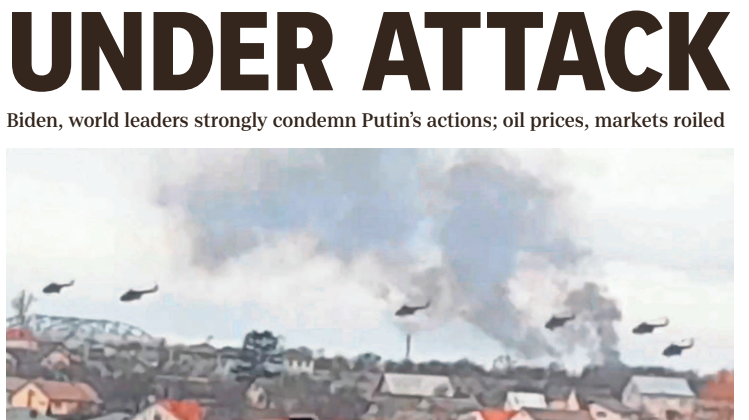
On February 25th, the times record shared images of helicopters flying over Kyiv, the capital of Ukraine, which Putin was almost certainly aiming to take. However, Russian troops were never able to overtake the city, and Ukraine maintained control of its capital. Heavy casualties have been seen on both sides, Russia suffering 1.2 million casualties, and Ukraine facing half as many. To this day, the war between Russia and Ukraine rages on after 4 years of conflict and failed peace negotiations.
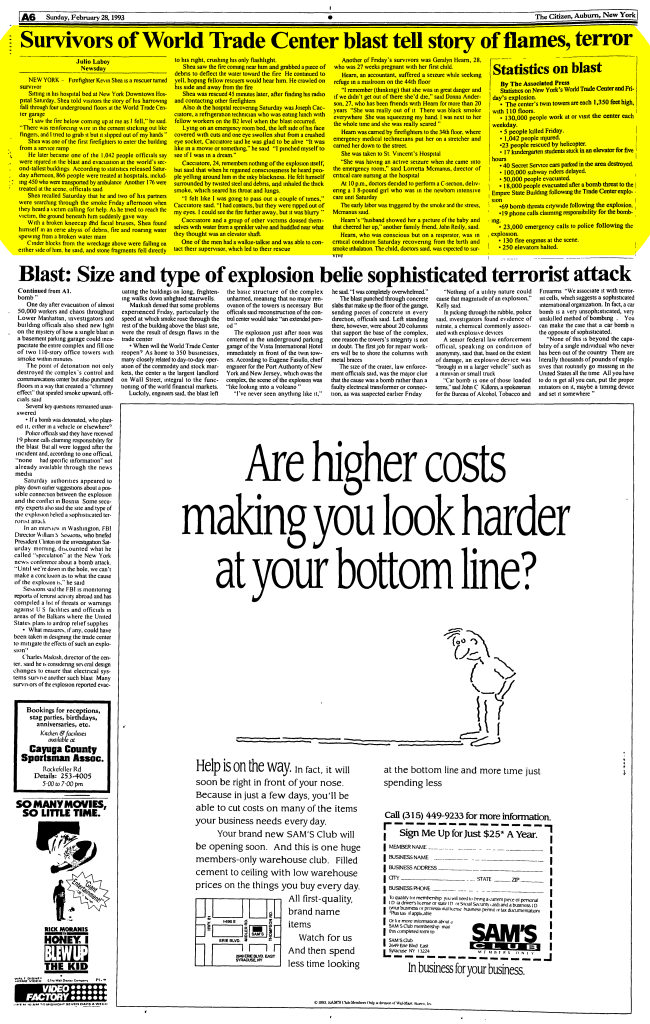
On February 26th, 1993, the World Trade Center in New York City suffered a terrorist attack, which foreshadowed what was to come less than a decade later. In the middle of the workday, just after noon, a car bomb was detonated in the parking garage of the North Tower. The explosion was strong enough to create a 100-foot crater that cut through multiple stories of the skyscraper. While only six people were killed (most dying immediately from the explosion), over 1000 others suffered non-fatal injuries. A few survivors of the attack shared their stories in The Citizen, published on February 28th, 1993 in The Citizen. One man said he remembered wires sticking out of the cement as the fire burned, another described how the surreal moment felt like something out of a movie.
The terrorists behind the attack belonged to an Islamic extremist group led by Ramzi Yousef. Yousef was the mind behind the attack, though it didn’t go entirely to plan. He had hoped that the explosion would be strong enough to cause the North Tower to collapse, landing on top of the South Tower and taking down the entire complex. Thankfully, his plan was not successful, and it was only the North Tower that had been damaged in the bombing. However, this incident had a similar mission to the infamous day of September 11th, 2001, when two planes successfully took down both towers of the World Trade Center. While it didn’t stop the future attacks from happening, it alerted the United States to the threat of terrorism, which was growing in the United States.
(1945 – 1980s) The Good and The Bad: Wounded Knee Occupation, 1973
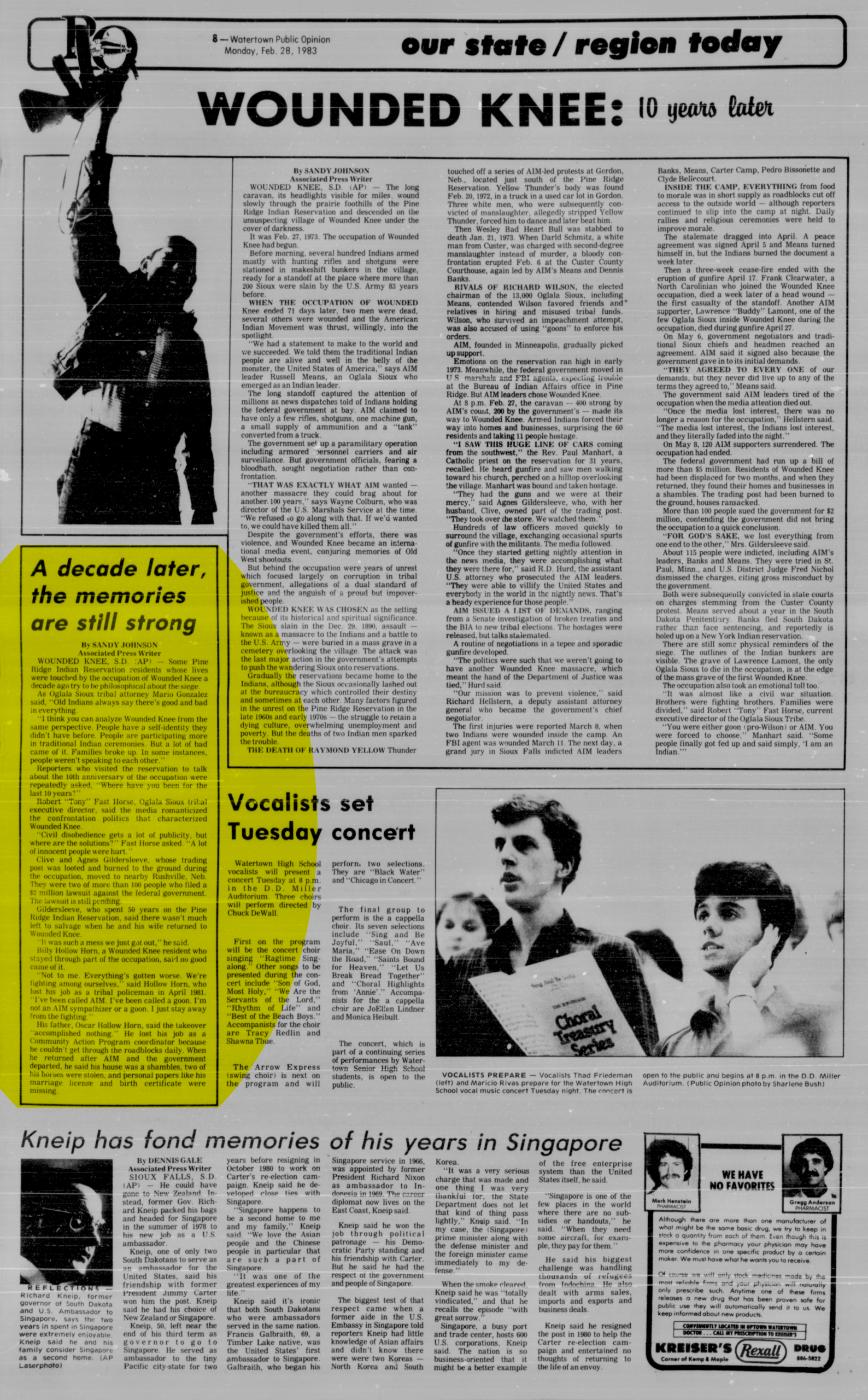
Wounded Knee, once the site of a massacre, saw renewed action on February 27, 1973, as over 200 native americans began to occupy the town. Members of the Oglala Tribe planned the occupation in an act of protest against broken treaties and a tribal leadership they saw as corrupt. Led by members of the American Indian Movement (the same group that occupied Alcatraz Island), they took control of the small community, a power they held for 71 days. Swarmed by media attention, the occupation quickly became something larger than just the town. Lots of heads were turned towards the uplifted native voices, and as a result, lots of people expressed their opinions on the occupation. The perspective of tribal attorney Mario Gonzalez in the Watertown Public Opinion, published on the 10th anniversary of the occupation’s start, stood out to me. He referenced something he remembers older Indians saying to him– “there’s good and bad in everything” and applied that notion to the occupation, which he believed had both good and bad. On one hand, he believes the situation at Wounded Knee brought many native americans a sense of self-identity they didn’t have before. However, he also acknowledged the damage caused by the occupation, from broken families to lives lost. I think this perspective is a way that a lot of historical events can be viewed, because history is nuanced!
If you aren’t familiar with the events in Germany leading up to the Nazi regime, you may not realize just how quickly Hitler was able to gain power. The fire in the Reichstag was one step that accelerated his climb to the top. The fire burned in the parliament building, which was located in Berlin, late at night on February 27th, 1933. The arsonist was Marinus Van der Lubbe, a Dutch communist. By the time firefighters arrived at the scene, the fire had quickly spread to the entire building. In the Newark Evening News, the following days, journalists began to speculate on the actions the Nazi party would take in the wake of the fire. Specifically, they noted the implications of barring communist party members from counting in future elections. As speculated, the Nazi regime used this attack as leverage to launch their own against the communist party. As a response, the German government announced the Reichstag Fire Decree, which allowed it to commit mass arrests of communists in Germany. This was strategic; through imprisoning those aligned with their opposing political party, the election on March 6th saw a drastic lean of votes in favor of the Nazi party. The fire and its implications are a reminder of how often we don’t realize that historical moments are happening until we reflect on them years later.
Join me again next week to discover more of history’s hidden gems and timeless tales.
Explore the “Read All About It” archives to read stories that spotlight our partners and their communities, announcements from our team, updates on current projects, and so much more. Discover articles about engagement, outreach, primary sources, community, digitization, education, and other topics of interest. Delve into the happenings in this week in history and take a deep dive into the events and people who helped shape our communities, our nation, and the world.
Hear Ye, Hear Ye, READ ALL ABOUT IT!
Advantage Archives works to build strong, community-based partnerships to provide free online access to local history, making it discoverable and easily accessible to anyone, anywhere, at any time, on any device. This allows communities to understand and connect to their past in a meaningful way. Through the Community History Archive search platform, we provide the community with the means to explore, discover, learn from, connect with, and share the stories of the people, places, and events that shaped their community.
The Community History Archives are intended to serve as a “portal to the past”, allowing local primary source documents to give an accounting of history as told by the individuals that witnessed it. Advantage Archives guiding principals center around building strong community-based partnerships, which is why we enter into them with the intent of shouldering our fair share, and taking the burden off of the community for the ongoing costs associated with storage, hosting, development, and maintenance of the Community’s History Archive. We are an active participant in the community’s efforts to make their collective history more accessible. The Community History Archives are maintained for free by Advantage and do not require a subscription, seat license, annual support contract, or any other ongoing costs or expenses to the institution or members of the community.
If you would like to see more local history online, please contact your local library, newspaper publisher, genealogical society, historical society, or educational institution, and encourage them to learn more about creating a Community History Archive or have them contact Advantage Archives at (855) 303-2727