



What was life like on these days, centuries ago? We’re off on an adventure to experience this week in history, and you do not want to miss it! From pandemics to blizzards and everything in between, join me as we experience history through the eyes of the past. Using the FREE resources provided by the Community History Archives, we can gain a first-person perspective of the historical events that shaped the world we live in today.
Today, life before the pandemic can feel like decades ago. It’s hard to believe that this week, 6 years ago, on March 11, Coronavirus (or COVID-19) was declared a pandemic by the World Health Organization. Looking at old articles from March of 2020 is the weirdest blast from the past for me. For example, I found this article in the Andrews County News titled “COVID-19, What It Is and What To Do,” and it is such a strange reflection of how much we underestimated the effect this virus would have on the world. This article was published on March 26th, 2020, and at that point, COVID was in the early stages in the United States.
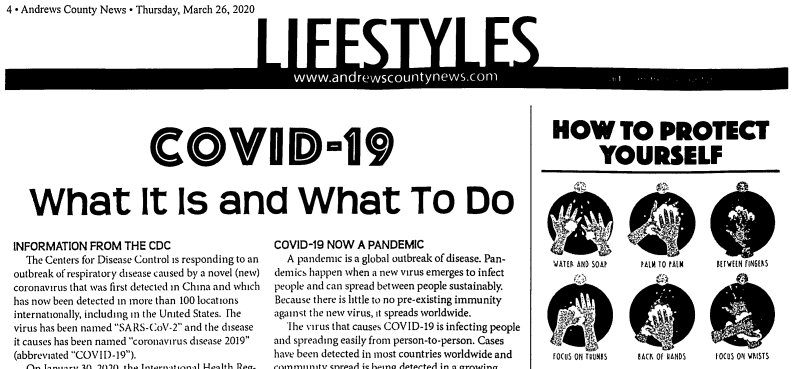
The article describes what the illness is, where it was believed to have come from, and a little information about the history of pandemics. I won’t rehash the details of COVID, because I’m sure we all are trying to forget it, but this article did make an interesting observation that in the last century, the majority of pandemics have been caused by Influenza, and this was the first time in recorded history that a pandemic was caused by coronavirus.
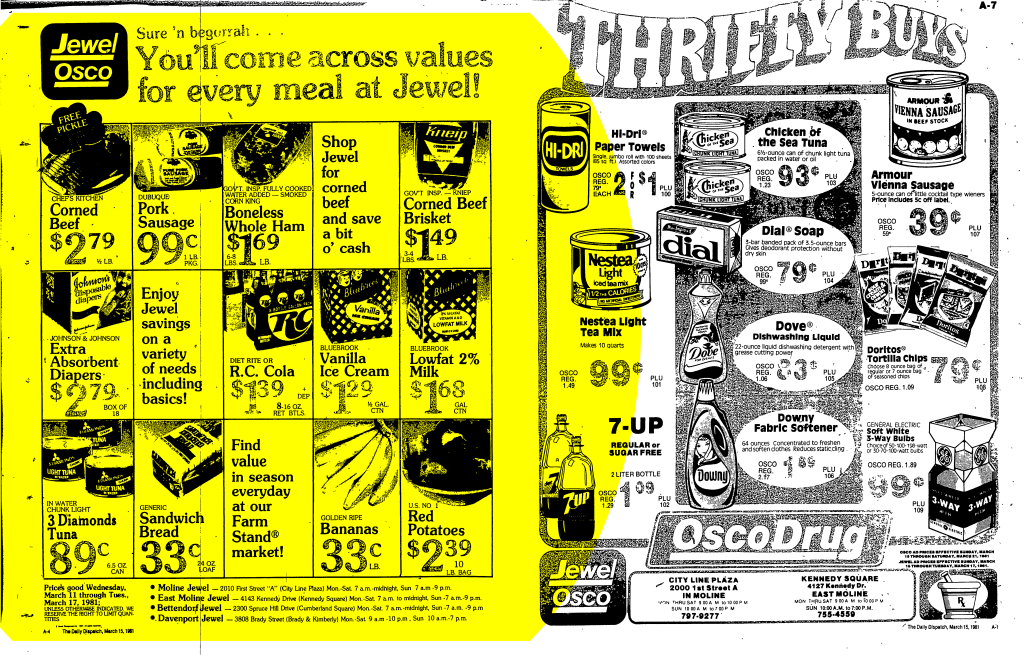
Most people my age have heard their grandparents reminiscing on how cheap everything used to be when they were young. When $5 stretched a long way, and $7.25 was a livable hourly wage. It’s hard for me to imagine prices being that low, having been born in the early 2000s, and I mostly chalked it up to nostalgia goggles. However, I was shocked when I found this advertisement from Jewel-Osco in the Daily Dispatch, published on March 15th, 1981, and saw just how low prices used to be. To put it into perspective, I decided to do a little price comparison for this week’s article. The store advertised value prices for various grocery items, which I have listed below with their price today.
24oz Loaf of sandwich bread: 33 cents in 1981, typically $2 or $3 in 2026
Box of 18 diapers: $2.79 in 1981, $11.99 in 2026
A Gallon of 2% Milk: $1.68 in 1981, around $2.49 in 2026
½ Gallon of Vanilla Ice Cream: $1.29 in 1981, between $3 and $6 in 2026
Isn’t it interesting to see which products have risen drastically in price and which ones are closer than expected? This was super informative to me, and I hope it is for you too!
(1945 – 1980s) Hellish Flames: Aeriel Bombing of Tokyo, 1945
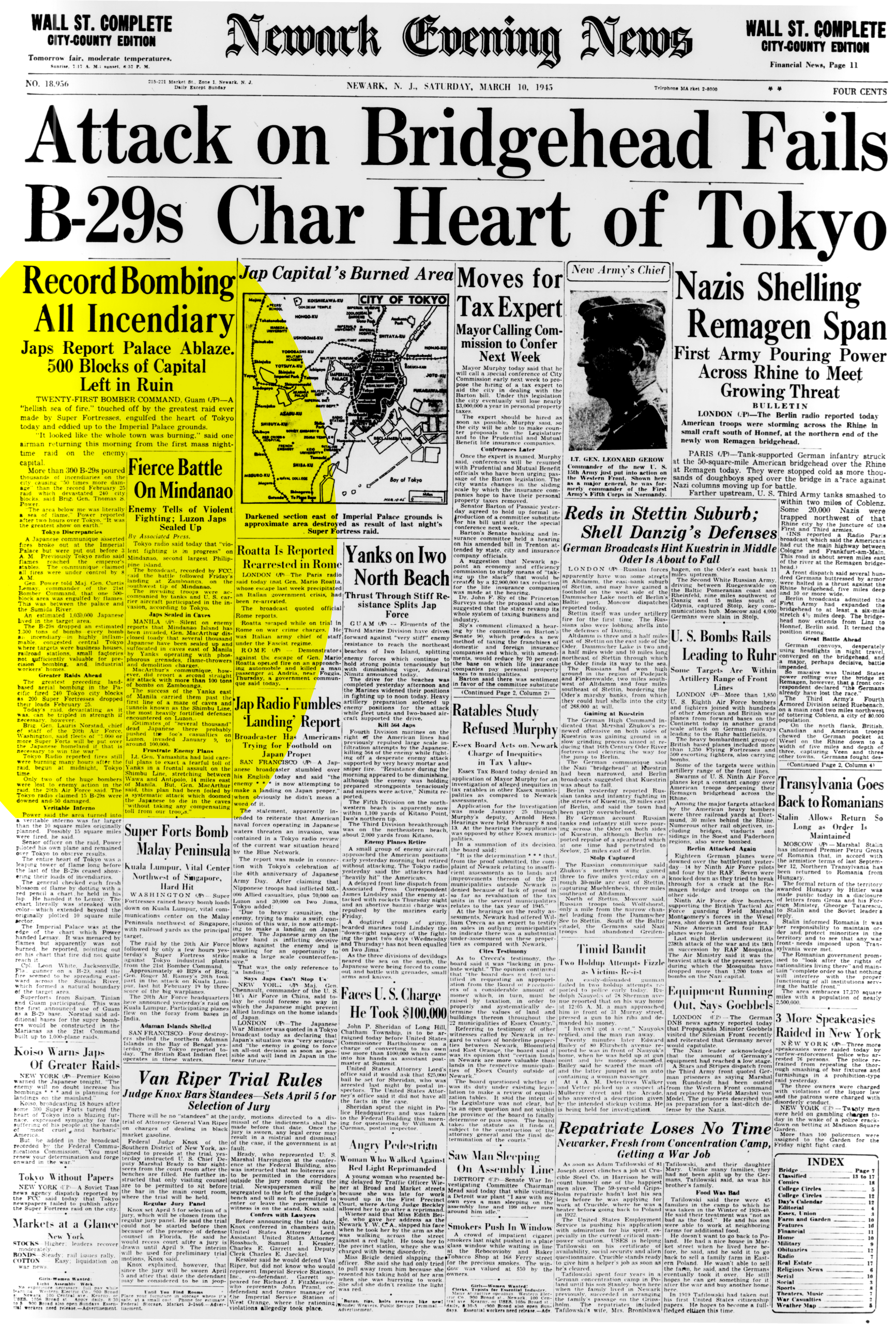
This week in 1945 was full of flames for those living in Japan. At this time, World War II was in full swing on both fronts. Between March 9 and 10, the United States dropped more than 300 incendiary bombs on Tokyo. In the Newark Evening News, the scene was described as a “hellish sea of fire”, one airman saying that it looked like the whole town was on fire after the first night. The fire was especially damaging in the area surrounding the Imperial Palace, which was burned along with an estimated 500 blocks of Tokyo. These two days of attacks with Napalm bombings left around 100,000 dead and disrupted the city’s industrial production heavily. This operation was the single most destructive aerial bombing raid in history, and came just months before Japan was subject to two atomic bombs.
The Butler Act was introduced to the Tennessee legislature in 1925 to ban the teaching of evolution in all universities and public schools within the state. The act didn’t explicitly name the theory of evolution, but rather prohibited any teaching of a theory that denies the biblical story of creation, and that man was made by god. Those who broke this law would be fined anywhere from $100 to $500 for each instance. Conversations surrounding the act were held by members of both parties, and the Marshall Gazette shared that not only was nearly the whole senate engaged in debates, but a large crowd of spectators also attended. The bill was passed in the Tennessee Senate on March 13th, 1925, with 24 members voting in favor, and only 6 voting against it.
This ruling was highly controversial and led to a Supreme Court case discussing its constitutionality. The ACLU sued the state of Tennessee in partnership with Science Educator John Scopes, who had been found to have violated the act. After the Tennessee Supreme Court decided it was not violating the Constitution because it did not explicitly enforce a single religious belief, the case was later overturned on a technicality. Despite the decision reversal, the law wasn’t repealed until 1967. This case has been cited in many arguments for the teaching of certain subjects in schools, and continues to be relevant to this day.
April Showers bring May flowers, but for the East Coast in 1888, March brought them a monster blizzard. From March 11 to March 14, a total of 58 inches of snow fell over the eastern coast of the United States and parts of Canada. Wind speeds reached a sustained speed of 45 MPH as states were covered in a thick blanket of snow. With such large amounts of snow, most modes of transportation were disabled, and people were stuck in their homes for days on end. The blizzard and effects that followed resulted in an estimated 400 deaths, as well as $25 million in damages (about $870 million in 2025). On March 22nd, 1888, the Warwick Advertiser published an article titled “Echoes from the Storm,” where they shared stories of New Yorkers from the blizzard. One story that stood out to me was of a family who had run out of ingredients to make food, and upon discovering that none of their neighbors had any either, the father traveled 3 miles through the snow drifts to purchase a sack of flour. Many of the stories shared a similar theme of community, as neighbors helped each other dig their way out of the snow. Despite the storm having tragedy, it also shows the strength of the community and the importance of looking out for the people around you.
Join me again next week to discover more of history’s hidden gems and timeless tales.
Explore the “Read All About It” archives to read stories that spotlight our partners and their communities, announcements from our team, updates on current projects, and so much more. Discover articles about engagement, outreach, primary sources, community, digitization, education, and other topics of interest. Delve into the happenings in this week in history and take a deep dive into the events and people who helped shape our communities, our nation, and the world.
Hear Ye, Hear Ye, READ ALL ABOUT IT!
Advantage Archives works to build strong, community-based partnerships to provide free online access to local history, making it discoverable and easily accessible to anyone, anywhere, at any time, on any device. This allows communities to understand and connect to their past in a meaningful way. Through the Community History Archive search platform, we provide the community with the means to explore, discover, learn from, connect with, and share the stories of the people, places, and events that shaped their community.
The Community History Archives are intended to serve as a “portal to the past”, allowing local primary source documents to give an accounting of history as told by the individuals that witnessed it. Advantage Archives guiding principals center around building strong community-based partnerships, which is why we enter into them with the intent of shouldering our fair share, and taking the burden off of the community for the ongoing costs associated with storage, hosting, development, and maintenance of the Community’s History Archive. We are an active participant in the community’s efforts to make their collective history more accessible. The Community History Archives are maintained for free by Advantage and do not require a subscription, seat license, annual support contract, or any other ongoing costs or expenses to the institution or members of the community.
If you would like to see more local history online, please contact your local library, newspaper publisher, genealogical society, historical society, or educational institution, and encourage them to learn more about creating a Community History Archive or have them contact Advantage Archives at (855) 303-2727