



I, like many, have been enjoying watching the Winter Olympics this month, and it got me thinking about past Olympic Games. That’s why I decided this week to focus on past Winter Olympic Games! A little background for you: the first Winter Olympics were held in 1924 in France, and were held every four years until 1936, but resumed their rotation in 1948. The original four sports were bobsleigh, curling, ice hockey, Nordic skiing, and skating.
The 2014 Winter Olympic Games, held in Sochi, Russia, from February 7-23, featured almost 3,000 athletes from 88 nations competing in seven sports. An article published in The Times Record on February 19, 2014, offered a look into the games, beyond just the medal counts. The newspaper shared inspiring stories of athlete resilience and motivation. For instance, the US women’s bobsled team overcame a rough start, which included crashing their sled into a wall, to ultimately win the silver medal.
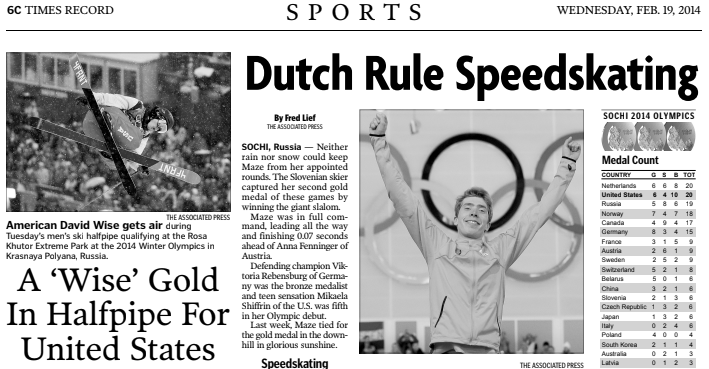
Another highlight was the story of freestyle skier Dave Wise, who secured a gold medal in the halfpipe event. Wise, who considers being a father his priority over being an athlete, credited his family’s support for his victory. Reportedly, his family’s presence and supporters holding up large pictures of his daughter helped motivate him and reminded him of his purpose for competing.
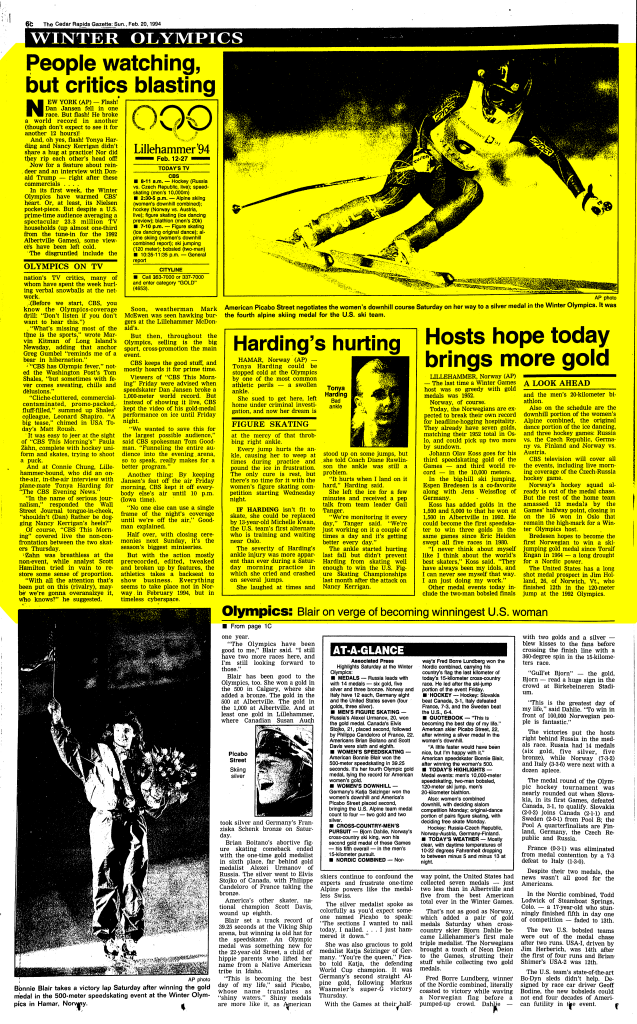
The 1994 Olympics were held in Lillehammer, Norway, from February 12-27. They hosted over 1700 athletes from 67 nations competing in 6 sports. That year, more eyes were brought to the games after the controversy surrounding figure skaters Tonya Harding and Nancy Kerrigan. Kerrigan was attacked after practice, leading to an injury that complicated her performance and landed her far out of podium reach. Her rival, Tonya Harding, went on to compete for gold but lost to Osaka Bauil, a skater from Ukraine. Despite drawing in massive audiences, viewers had many criticisms of the games broadcasting on CBS. In the Gazette, published February 20th, 1994, they share some of these critiques from TV critics and audiences alike. One common complaint was the overwhelming amount of commercials. Similarly, others argued that there were fewer sports than other fluff content. Russia took away the largest number of medals that year.
(1945 – 1980s) Setting the Skiing Scene: Squaw Valley Olympic Games, 1960
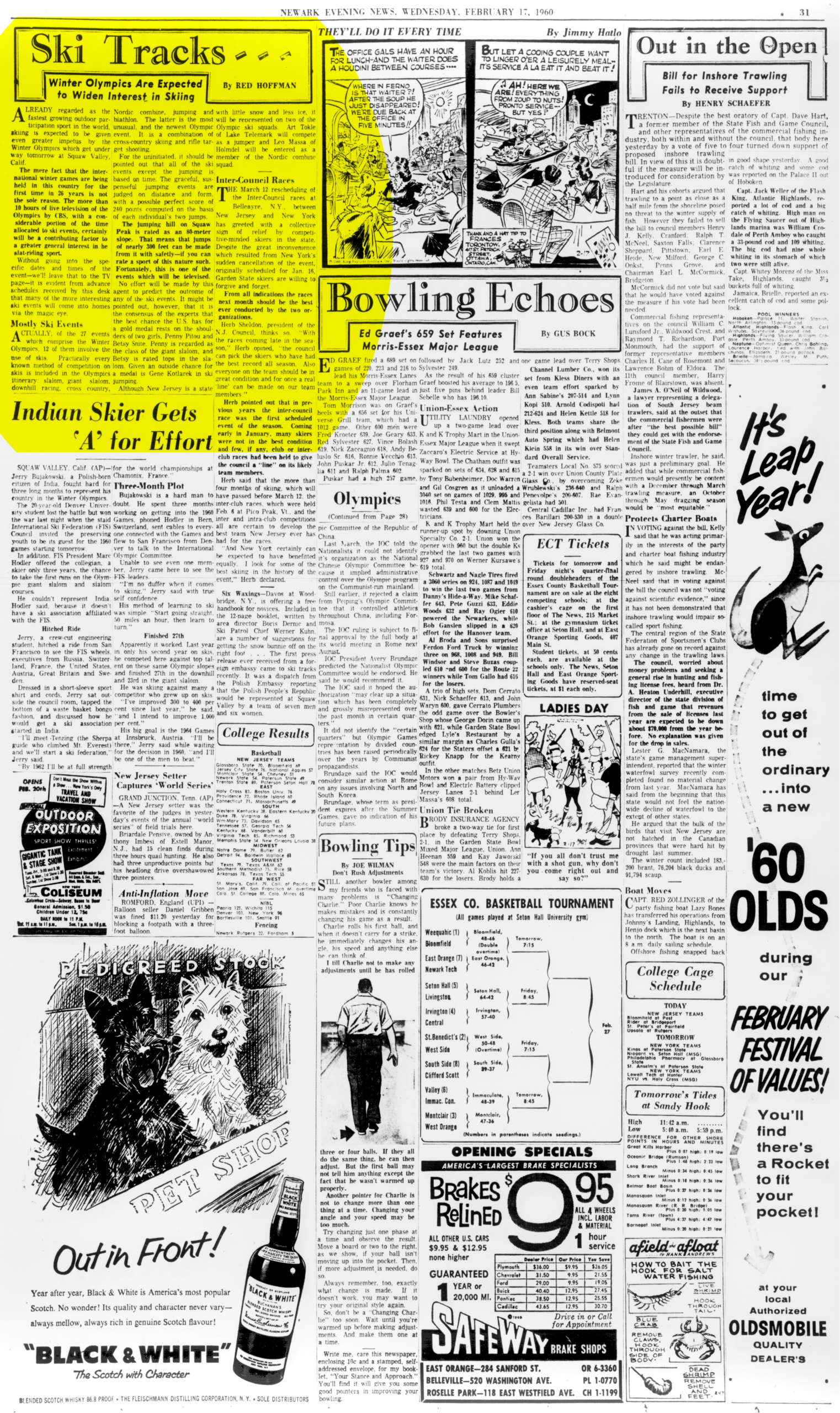
The 1960 Winter Olympic Games took place in Squaw Valley, California, from February 18th to 28th. The event saw 665 athletes from 30 nations competing in 4 sports, with skiing accounting for 12 of the 27 total events. Excitement for the skiing competitions was high. On the eve of the games (February 17th, 1960), the Newark Evening News published commentary expressing hope that the Olympics would boost interest in skiing. Particular attention was focused on the jumping hill, which featured an 80-meter slope designed to allow competitors to reach jump heights of 300 feet. The newspaper looked forward to the televised coverage of this specific event. Ultimately, the Soviet Union earned the highest number of medals that year.
In 1932, the United States hosted the Winter Olympic Games in Lake Placid, New York. The games were held from February 4-15, and hosted 252 athletes from 17 nations competing in 4 sports. The United States received the most medals. Before the games became televised in 1956, fans of the Winter Olympics had to find other ways to watch the competition. This sometimes looked like a delayed video presentation, like the one advertised in the Carthage Republican Tribune published on February 25th, 1932. They shared that a film featuring the most important events of that years olympic games were going to be shown by the chamber of commerce at their social event. Films like this were one of many ways fans were able to catch the action of the Olympics before they were just a TV station away!
I hope you enjoyed this little adventure into some of the past Winter Olympic Games. Join me again next week to discover more of history’s hidden gems and timeless tales.
Explore the “Read All About It” archives to read stories that spotlight our partners and their communities, announcements from our team, updates on current projects, and so much more. Discover articles about engagement, outreach, primary sources, community, digitization, education, and other topics of interest. Delve into the happenings in this week in history and take a deep dive into the events and people who helped shape our communities, our nation, and the world.
Hear Ye, Hear Ye, READ ALL ABOUT IT!
Advantage Archives works to build strong, community-based partnerships to provide free online access to local history, making it discoverable and easily accessible to anyone, anywhere, at any time, on any device. This allows communities to understand and connect to their past in a meaningful way. Through the Community History Archive search platform, we provide the community with the means to explore, discover, learn from, connect with, and share the stories of the people, places, and events that shaped their community.
The Community History Archives are intended to serve as a “portal to the past”, allowing local primary source documents to give an accounting of history as told by the individuals that witnessed it. Advantage Archives guiding principals center around building strong community-based partnerships, which is why we enter into them with the intent of shouldering our fair share, and taking the burden off of the community for the ongoing costs associated with storage, hosting, development, and maintenance of the Community’s History Archive. We are an active participant in the community’s efforts to make their collective history more accessible. The Community History Archives are maintained for free by Advantage and do not require a subscription, seat license, annual support contract, or any other ongoing costs or expenses to the institution or members of the community.
If you would like to see more local history online, please contact your local library, newspaper publisher, genealogical society, historical society, or educational institution, and encourage them to learn more about creating a Community History Archive or have them contact Advantage Archives at (855) 303-2727