



This week, we’re shifting our focus from significant historical events to the happenings in small towns. I selected a few random states and searched for intriguing clips from newspapers dated March 2nd to March 8th. I hope you find these small stories as interesting and fun as I do!
Have you ever been late because of traffic? Our first story is from Clarksdale, Mississippi, where a young man found himself in that exact situation. On March 5, 2008, the Clarksdale Press Register reported on a father’s decision to help his son, who was running late for a date. Instead of taking a shortcut on the road, they decided to take to the skies and flew in a plane to the son’s date. They flew from their home to a nearby golf course, where they made an unauthorized landing. Local authorities expressed their disbelief, emphasizing that this was a poorly thought-out plan and not a responsible way to avoid traffic.
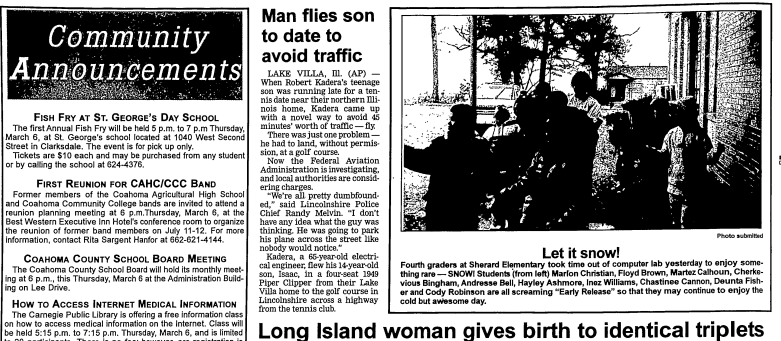
Unfortunately, the newspaper did not reveal whether the son arrived on time for his date, but one can imagine he likely got there much sooner than he would have if they had driven!

Ironically, our next article is also about planes, and their use in commercial (rather than personal) flights. On March 7th, 1991, the Cranston Herald reported that the T.F. Green Airport was seeing drastic increases in air traffic. In January alone, a reported 1.5 million pounds of fish were transported via plane out of the airport. In addition, that month they saw over 1 million pounds of mail pass through their airport, a 30% increase from the previous year. They interviewed several employees of airline companies for an insider perspective on why they had seen such an increase in air traffic. The common conclusion was that it had become increasingly convenient for consumers and businesses alike to transport mail through the air. 25 years later, the United States still ships a significant portion of its mail via plane. In 2024, the USPS estimated that they flew 3.5 million pounds of mail each day!
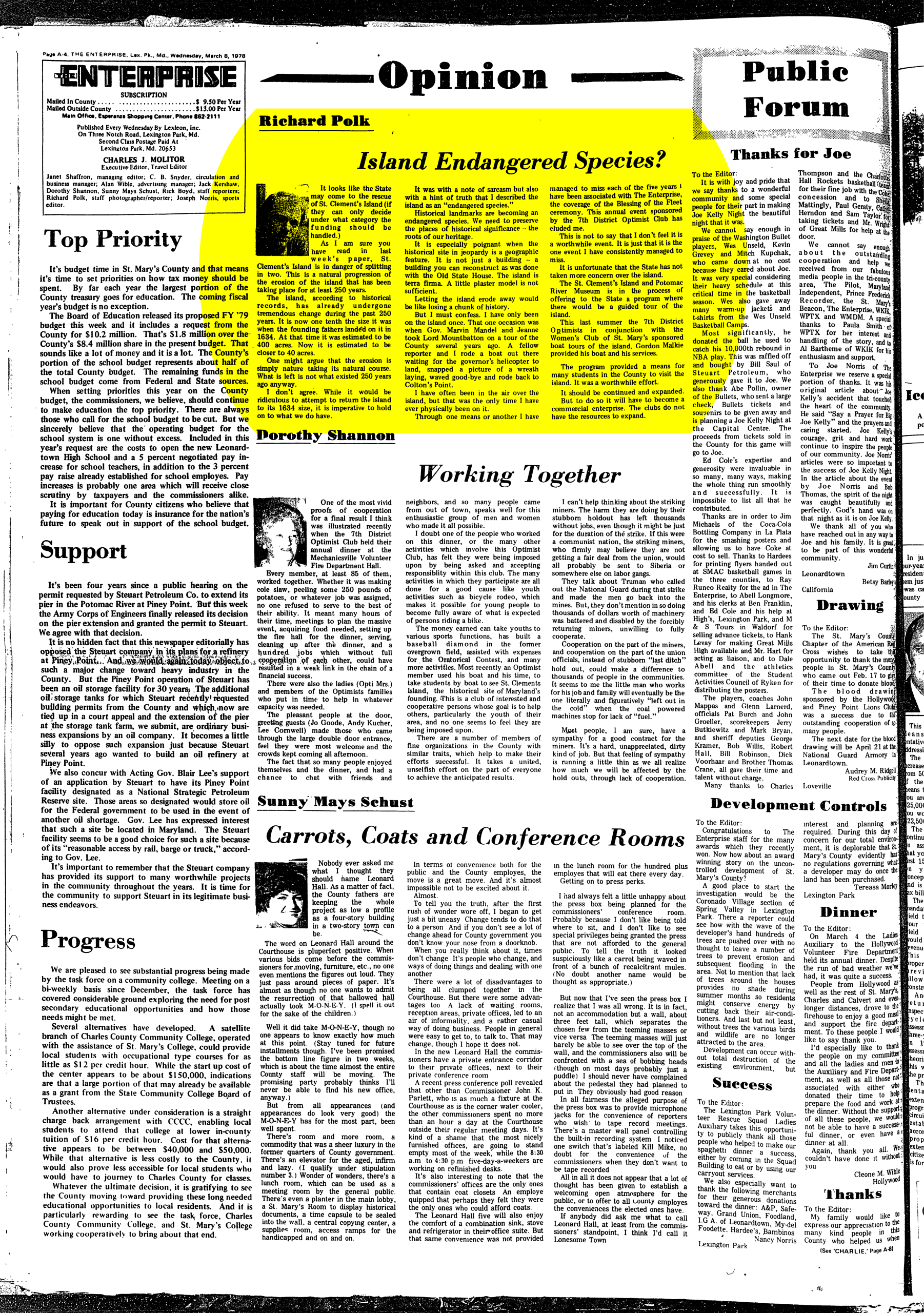
(1945 – 1980s) Eroding or Endangered: St Clements Island, 1978
Can a landform be considered an endangered species? Richard Polk, author of our next article, would say yes. In The Enterprise, published on March 8th, 1978, in Leonardtown, Maryland, Polk discussed the deteriorating state of a nearby island. The island is a historic landmark and state park where colonists landed back in 1634 during their journey to America. St. Clements Island, at that point one-tenth of its original size, was reportedly at risk of splitting in half from erosion. He named the island an ‘endangered species’ because of its impending extinction. Part of his argument was focused on preserving the island as a historical landmark, and his disappointment in its lack of upkeep. If you’re like me, you may be wondering if this island made a recovery or disappeared into the sea. The good news is that the island still exists today and is an estimated 62 acres (larger than the estimated 40 acres Polk cited in his article). While the St Clements Island Museum is closed currently for reconstruction, you can still visit the island next time you’re in Maryland to learn more about its history!
Recently, we talked about the history of the winter Olympics, and one of the oldest sports competed in them was ice skating. Today, the sport is filled with artistry, gravity-defying leaps, and dizzying turns. However, the sport hasn’t always looked that way. In the Brownsville Herald, published on March 8th, 1937, they shared pictures of Evelyn Chandler. Nicknamed “America’s queen of figure skaters,” is photographed performing a few tricks on the ice. One of the tricks she performed included an Arabian cartwheel– a move where the skater does a complete somersault without coming in contact with the ice. Another feature of her program was a dizzying 19 turns in succession. The Arabian cartwheel is not banned, but is uncommon in current figure skating programs, and today most figure skaters complete 8 or more turns in a row. I always find it interesting to see how sports have evolved!
Finally, we have a story of a tricky thief that sounds like a wild west cartoon. In the Attica Ledger, published on March 7th, 1889, they share an update on one man’s criminal sentencing. This R. Vines was a clerk from Chicago who stole thousands from his coworkers and then proceeded to ship himself inside a trunk to St. Louis. Yes, you read that correctly. The update came after Vines faced trial, where he claimed insanity. Their evidence to back this claim was Vines’ incessant vanity. A witness testified that previously the man had broken his nose and was paranoid about ruining his beauty, calling upon the witness to reset his nose multiple times. He claimed that this obviously showed that the man was insane. The jury reportedly testified for only a few minutes before deciding that Vines was insane at the time of his crimes, and he was therefore sent to an insane asylum. Whether he was actually insane or if this was another crazy scheme to get out of jail is up to you to decide, but after hearing this story, I wouldn’t put it past him for this to be a con!
I hope you enjoyed these smaller stories from the past! Join me again next week to discover more of history’s hidden gems and timeless tales.
Explore the “Read All About It” archives to read stories that spotlight our partners and their communities, announcements from our team, updates on current projects, and so much more. Discover articles about engagement, outreach, primary sources, community, digitization, education, and other topics of interest. Delve into the happenings in this week in history and take a deep dive into the events and people who helped shape our communities, our nation, and the world.
Hear Ye, Hear Ye, READ ALL ABOUT IT!
Advantage Archives works to build strong, community-based partnerships to provide free online access to local history, making it discoverable and easily accessible to anyone, anywhere, at any time, on any device. This allows communities to understand and connect to their past in a meaningful way. Through the Community History Archive search platform, we provide the community with the means to explore, discover, learn from, connect with, and share the stories of the people, places, and events that shaped their community.
The Community History Archives are intended to serve as a “portal to the past”, allowing local primary source documents to give an accounting of history as told by the individuals that witnessed it. Advantage Archives guiding principals center around building strong community-based partnerships, which is why we enter into them with the intent of shouldering our fair share, and taking the burden off of the community for the ongoing costs associated with storage, hosting, development, and maintenance of the Community’s History Archive. We are an active participant in the community’s efforts to make their collective history more accessible. The Community History Archives are maintained for free by Advantage and do not require a subscription, seat license, annual support contract, or any other ongoing costs or expenses to the institution or members of the community.
If you would like to see more local history online, please contact your local library, newspaper publisher, genealogical society, historical society, or educational institution, and encourage them to learn more about creating a Community History Archive or have them contact Advantage Archives at (855) 303-2727