



History is being made every day, and the week of January 26th has historically been extra significant. From huge moments in pop culture history to the start of massive civil rights movements, these day-to-day events became something much bigger. Using the resources available in the Community History Archives, we can experience the events of this week in years prior through the eyes of those who lived through them. Join me as we take a closer look at some events that changed the course of global, national, and pop culture history!
Super Bowl 38, which took place on February 1, 2004, is infamous for its halftime performance. The football game between the Carolina Panthers and New England Patriots was quickly overshadowed after a performance by Janet Jackson and Justin Timberlake went awry. The halftime show, produced by MTV, featured Jackson’s music, but Timberlake was brought out to perform his song “Rock Your Body” with her. During the last line of this song, Timberlake ripped part of Jackson’s costume off in a planned stunt, but what was revealed was much different from what they had planned. The idea was for Timberlake to reveal a red lace bra under her costume, a play on the lyric he was singing about removing clothing. Instead of lace, Jackson’s breast was revealed on a broadcast to 144 million viewers. Cameras quickly cut to a wide shot, but the damage had already been done.
Following the incident, statements were made by Timberlake, Jackson, and the NFL. The NFL was quick to assure viewers that they were unaware that partial nudity would be present in the halftime show. They proceeded to cut ties with MTV, which had been in charge of producing the halftime show in years prior, and Viacom silently blacklisted all of Jackson’s music. Timberlake made a statement at an awards ceremony the following week, where he apologized for the malfunction and reiterated that the plan was never to reveal Jackson’s nude chest. In the years following, Jackson would express feeling humiliated by the incident, and believed the outrage directed towards her was unjustified. This halftime performance quickly became an infamous pop culture moment and changed the reputation of Janet Jackson.
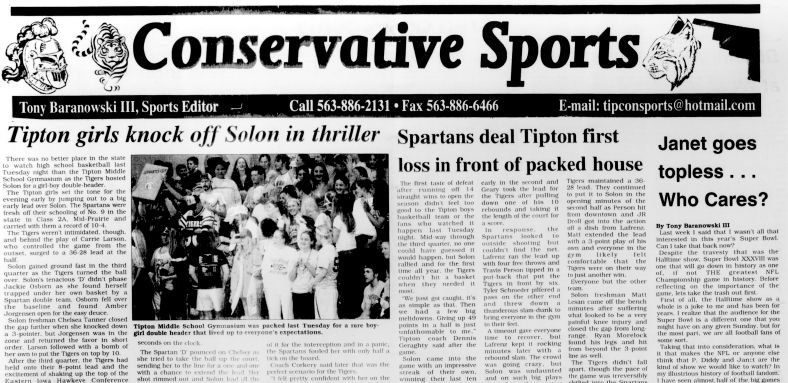
Many have debated whether Jackson’s wardrobe malfunction was planned or truly accidental. Commentators and viewers alike were quick to accuse Jackson of planning the whole thing. Even in small-town papers, like the Tipton Conservative, her name was being brought up. On February 4th, 2004, Sports Editor Tony Baranowski III shared his take on the show. He, like many, argued that the incident was entirely planned and that there was no way they didn’t mean to expose Jackson like that. However, he differed from public opinion by saying that he didn’t think it was as big a deal as many were making it. He reasoned that a little flesh isn’t going to scar anyone for life, and that the Super Bowl was never inherently kid-friendly.
An exciting journey into space quickly turned into a nightmare on January 28, 1986. The United States had been preparing for the Space Shuttle Challenger to complete its mission of launching the second Tracking and Data Relay Satellite, as well as releasing and retrieving a smaller satellite to survey Halley’s Comet. This mission featured a unique crew, as one of the seven members was not a professional astronaut. In 1984, a contest was held to select a teacher to accompany the crew. The winner would travel to outer space, teach lessons while in orbit, and then return to Earth to share their experience with students across the United States. The winner of this contest was Christa McAuliffe, a teacher from Concord, New Hampshire.
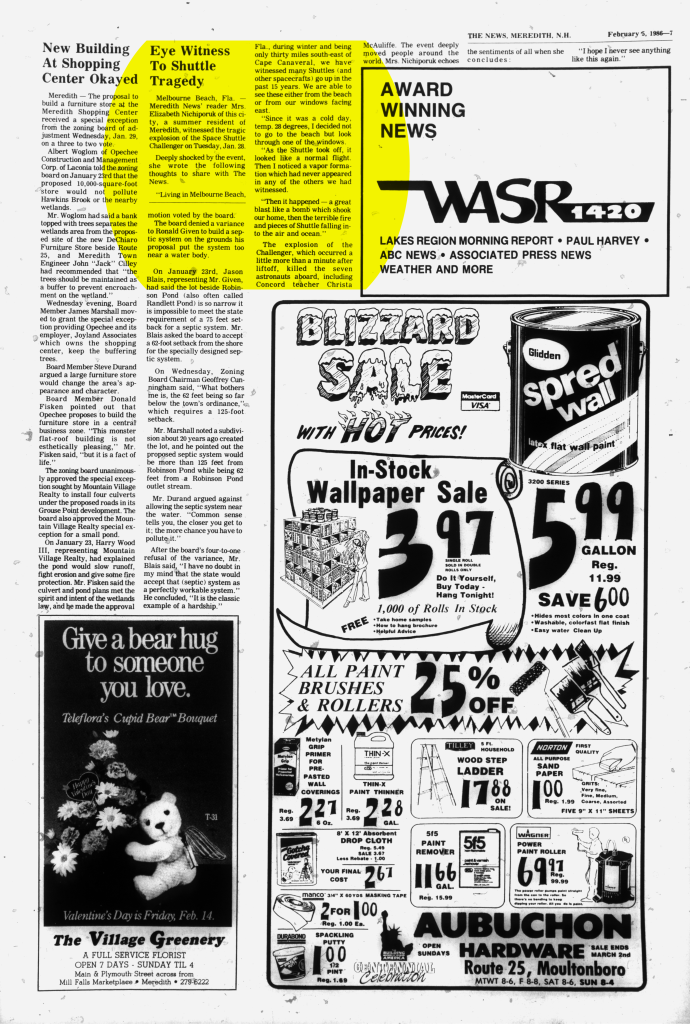
Before the tragic launch day, the Challenger shuttle encountered several issues. The launch was delayed by a few days due to the late landing of another shuttle mission. The night before the launch, Cape Canaveral, Florida, experienced an unusual cold snap, resulting in ice covering the launch pad. Despite these setbacks, everything seemed in order. However, just 73 seconds after liftoff, the shuttle exploded. An eyewitness interviewed by Meredith News described it as “a great blast like a bomb, which shook our home, followed by the terrible fire and pieces of the shuttle falling into the air and ocean,” as she watched from her home near the launch site.
The explosion resulted from failures caused by the icy cold weather. The crew cabin separated during the initial explosion and then plummeted into the sea. It is widely believed that the crew members likely lost their lives before their descent into the ocean, probably due to the pressure and lack of oxygen. This year marks the 40th anniversary of the Space Shuttle Challenger explosion.
(1945 – 1980s) Waves of Change: Greensboro Sit-Ins, 1960
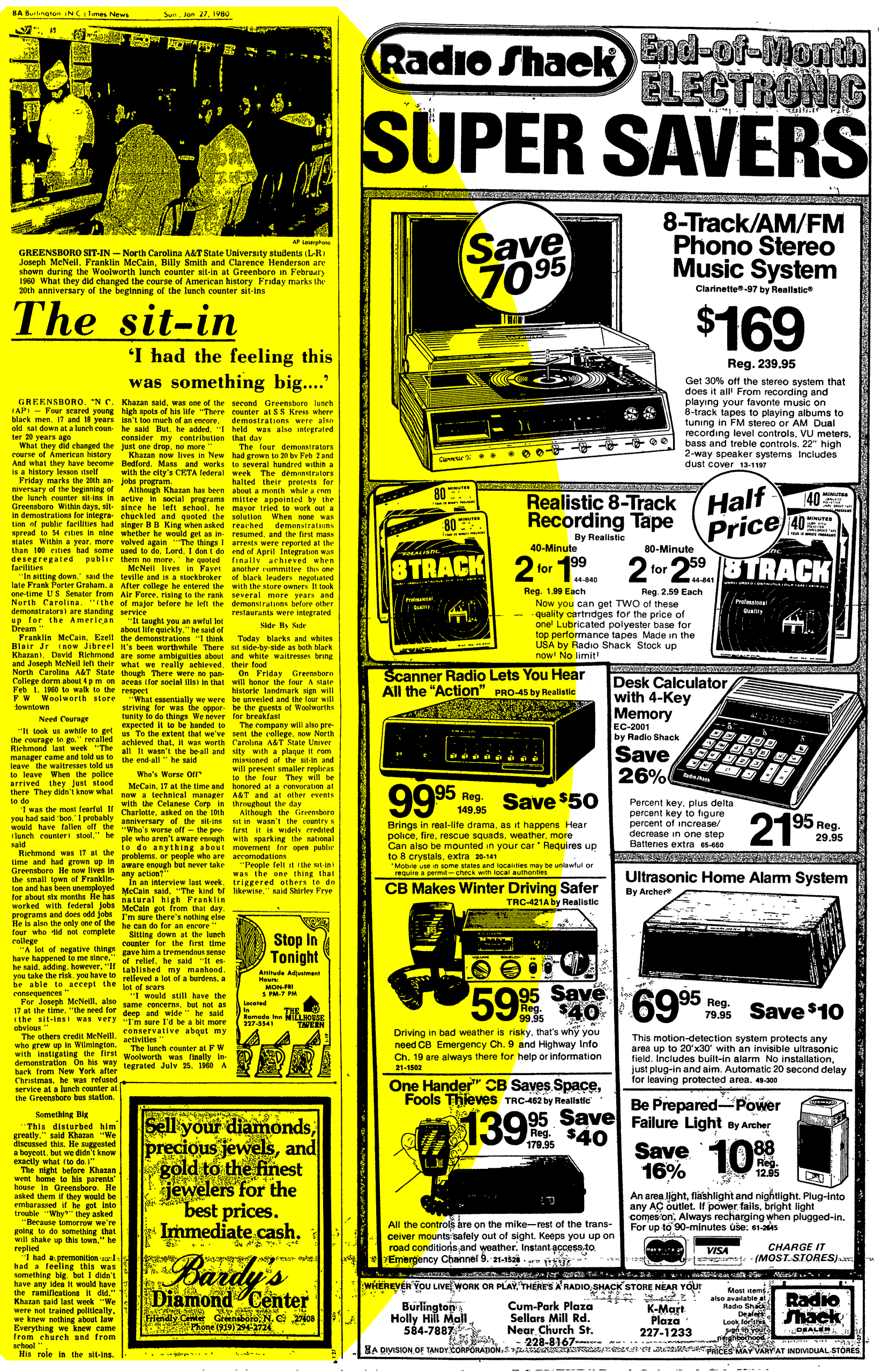
During the 1960s, segregation was running rampant in the South. Despite the abolition of slavery in 1865 and Brown v. Board eliminating school segregation in 1954, most public areas were still racially divided. On February 1, 1960, in Greensboro, North Carolina, four college students decided this needed to change. Ezell Blair Jr, Franklin McCain, Joseph Michael, and David Richmond staged a sit-in protest at Woolworth’s lunch counter. When they sat down, they were refused service, but they did not leave. Police were called, but they were permitted to stay as they were not instigating any trouble. The media was tipped off by another store owner, and they quickly arrived to photograph the moment. The four young men stayed at the lunch counter until the store closed. The next day, they returned with more students and did the same thing. This sparked a movement across the South as students staged sit-ins at their local segregated dining facilities. Their peaceful act of protest was highly successful, and come summer, most dining facilities in the area were integrated.
On the 20th anniversary of the first sit-in, the Daily Times News in Burlington, North Carolina, shared conversations they had with the Greensboro Four. Richmond recalls being so scared he could’ve easily fallen off his chair, and acknowledged the amount of courage they required to be able to execute their plan. Ezell Blair Jr talked about the moments leading up to the sit-in, where he felt a gut instinct that they were about to do something big. McCain described the feeling of sitting down at the counter as high as no other, and credits the moment as when he felt like he reached manhood. Their story is proof that no matter how young you are, no matter how small an action you take, your voice matters and can start a wave of change.
For the people imprisoned in the Auschwitz Concentration Camp, one can only begin to imagine how long each day felt as they awaited liberation. The strength it must have taken to endure the atrocities of the Holocaust daily was undoubtedly immense, with each day presenting its own battle. This struggle was likely even more pronounced in the weeks leading up to January 27, 1945—the day Auschwitz was liberated.
Looking back a few months to July 1944, Soviet forces liberated Majdanek, another Nazi concentration camp. The revelations of the horrors inflicted by Nazi Germany fueled the Allies’ resolve to continue fighting. Conversely, the liberation of Majdanek instilled fear in Nazi SS officers, who worried that Auschwitz would be next. Observing how quickly the Allies documented the crimes at Majdanek, the SS realized they needed to destroy as much evidence of their atrocities as possible. They began to eliminate documents, including prisoner records. As the Soviet forces drew nearer, they dismantled the crematoria used for gassing prisoners, an operation carried out by those imprisoned in the camps. Their final attempt to conceal evidence before the Soviets arrived involved the forced evacuation of prisoners from the camp. Approximately 58,000 prisoners were compelled to march nearly 40 miles to a secondary location, from which they were divided and sent to different German camps. By reducing the number of survivors in Auschwitz, they hoped to leave little evidence for the Soviets to discover upon their arrival.
The Quincy Herald-Whig shared the story of Dr. Bela Fabian, one of the prisoners in Auschwitz, who was transported to another camp. He confirmed that their relocation was driven by fear of the advancing Russian forces. When the liberation finally occurred, just 8,000 prisoners remained at Auschwitz, many too weak to complete the death march to other camps. Almost all the SS officers had abandoned their posts, leaving the prisoners to wait and see if liberation would come. Tragically, many died while waiting, most commonly from illness and starvation. When the Soviet Army finally arrived, they were horrified by what they encountered. It was a day of hope for those still alive at Auschwitz, a hope that their nightmare was finally over, but it was also a day of sorrow for those who did not survive long enough to witness it.
Join me again next week to discover more of history’s hidden gems and timeless tales.
Explore the “Read All About It” archives to read stories that spotlight our partners and their communities, announcements from our team, updates on current projects, and so much more. Discover articles about engagement, outreach, primary sources, community, digitization, education, and other topics of interest. Delve into the happenings in this week in history and take a deep dive into the events and people who helped shape our communities, our nation, and the world.
Hear Ye, Hear Ye, READ ALL ABOUT IT!
Advantage Archives works to build strong, community-based partnerships to provide free online access to local history, making it discoverable and easily accessible to anyone, anywhere, at any time, on any device. This allows communities to understand and connect to their past in a meaningful way. Through the Community History Archive search platform, we provide the community with the means to explore, discover, learn from, connect with, and share the stories of the people, places, and events that shaped their community.
The Community History Archives are intended to serve as a “portal to the past”, allowing local primary source documents to give an accounting of history as told by the individuals that witnessed it. Advantage Archives guiding principals center around building strong community-based partnerships, which is why we enter into them with the intent of shouldering our fair share, and taking the burden off of the community for the ongoing costs associated with storage, hosting, development, and maintenance of the Community’s History Archive. We are an active participant in the community’s efforts to make their collective history more accessible. The Community History Archives are maintained for free by Advantage and do not require a subscription, seat license, annual support contract, or any other ongoing costs or expenses to the institution or members of the community.
If you would like to see more local history online, please contact your local library, newspaper publisher, genealogical society, historical society, or educational institution, and encourage them to learn more about creating a Community History Archive or have them contact Advantage Archives at (855) 303-2727